Sales Force Management and Field Staff Productivity for Ayurvedic Distributors in India
Most Ayurvedic distributors understand how to manage their product portfolio. Fewer have a structured approach to managing the people who sell it — and the difference between a distribution business that grows steadily and one that stagnates is usually found in how the owner hires, assigns, tracks, and reviews field staff.
This guide covers the four field staff roles in a growing distribution business, the five-step framework for building a productive sales team from the first hire, the operating disciplines that separate high-output field teams from high-cost ones, and the most common mistakes that reduce field productivity without the distributor realising the source of the problem.
Four Field Staff Roles in an Ayurvedic Distribution Business
As a distributor's account base grows, the field team evolves from a single person doing everything to a structured team where each role has a distinct accountability. Understanding when each role becomes necessary — and what it should be measured against — prevents both overstaffing in early stages and understaffing as volume scales:
| Role | Primary accountability | When to hire | Key daily metric |
|---|---|---|---|
| Field Sales Executive | Beat coverage — visiting assigned accounts on schedule, collecting orders, and building retailer relationships; primary link between distributor and retailer | From day one; the first hire before any other field role; one executive per 80–120 active accounts depending on territory density | Accounts visited versus beat plan; orders collected versus account potential |
| Delivery and Collection Staff | Physical stock delivery to retailer accounts on time; collection of outstanding payments at delivery; daily cash and cheque reconciliation with the office | When daily delivery volume exceeds what the sales executive can handle alongside visit responsibilities; typically when delivering to more than 15–20 accounts per day | Deliveries completed versus dispatch schedule; collections versus outstanding dues at each account |
| Office / Billing Staff | Invoice generation, scheme entry, stock register maintenance, secondary sales data compilation, and principal report preparation; back-office support for field operations | When the owner is spending more than two hours per day on billing and back-office work that could be delegated; critical before secondary sales reporting volume becomes unmanageable | Invoice turnaround time; accuracy of scheme entries and secondary data submissions |
| Senior Sales Executive / Area Supervisor | Oversight of two or more junior sales executives; beat compliance monitoring; new account development in expansion areas; escalation point for retailer relationship issues | When the team exceeds three field sales executives and the owner cannot maintain direct daily oversight of every person's beat compliance | Team beat compliance rate; new active accounts added per month; escalation resolution speed |
Five-Step Framework for Building a Productive Field Team
The distributor who builds a field team with a structured sequence — starting with clear account assignments before the first hire, not after — produces a measurable sales output from the first month. The distributor who hires first and structures later typically spends six months managing confusion about who owns which accounts:
Map the account base and assign territory boundaries before the first hire
Before placing any field hire, the distributor should map the full active account base by geography — ideally by PIN code or colony cluster — and define clear territory boundaries for each planned field position. This map determines how many field people are actually required and what each person's account assignment will be from day one. A field person who joins without a defined territory assignment typically gravitates toward the easier accounts close to the warehouse and avoids the more distant or more demanding ones. A territory map established before joining removes this discretion: the person covers the assigned accounts, and performance is measured against that specific assignment.
Set the beat plan and daily call norm in the first week, not after the first month
The beat plan — which accounts are visited on which days of the week — should be defined and agreed with the field person in the first week of joining, using the territory map from step one. The daily call norm (how many accounts per day is expected and achievable in this territory) should also be established in week one, based on account density and travel distance. A beat plan created in the first week gives the distributor a baseline for daily tracking from week two onwards. A beat plan created after the first month is being retrofitted around the habits the field person has already developed — which are almost always more convenient for the person and less productive for the distributor than a structured plan would have been.
Assign monthly targets at the account level and communicate them before the month begins
Monthly targets should be broken down to the account level — not as a single territory number — and communicated to the field person before the first of each month. The account-level breakdown tells the field person which accounts deserve additional visit time and which are performing near their natural ceiling. It also gives the distributor a diagnostic tool: if a person is achieving the territory total but a specific cluster of accounts is systematically underperforming, the account-level view reveals it immediately. Territory-total targets without account-level breakdown hide the specific pockets of underperformance that, if addressed, would produce the growth the distributor is looking for.
Run a daily check-in and a weekly review as non-negotiable operational rhythms
Two rhythms together close most productivity gaps before they become entrenched. The daily check-in — a five-minute WhatsApp message or phone call covering accounts visited and orders collected — tells the distributor immediately if a field person did not complete their beat that day and allows a same-day conversation about why. The weekly review — 15 to 20 minutes, covering weekly sales versus target, accounts missed, and any field observations — allows course-correction before the shortfall accumulates to a significant monthly gap. A distributor who relies only on the month-end review to assess field performance typically discovers problems after 25 days have passed and only five days remain for recovery.
Run a structured monthly performance review that distinguishes field activity from territory conditions
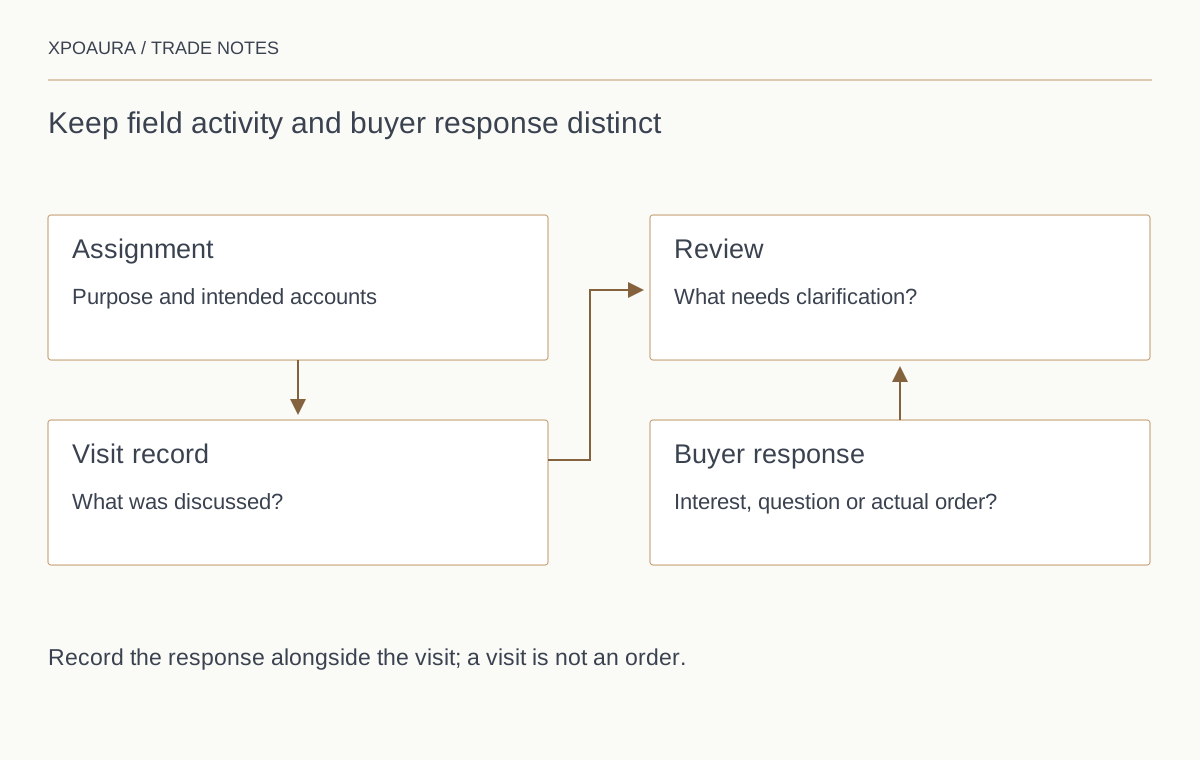
The monthly performance review should assess two distinct questions: did the field person execute the beat plan and activity requirements as agreed? And did the territory produce the commercial outcome expected? These are separate questions with separate remedies. If beat compliance was high but sales were low, the problem is the territory target or the commercial conditions — not the person. If beat compliance was low and sales were also low, the problem is field activity — and the conversation should be about accountability. A performance review that conflates activity compliance with commercial outcome typically leads to demotivating the field person who covered their beat in a difficult month, and under-managing the one who reached sales targets by concentrating on easy accounts while avoiding the harder ones.
Four Operating Disciplines for High-Output Field Teams
The difference between a field team that consistently delivers against its account base and one that produces unpredictable monthly results lies in four disciplines the distributor must enforce — not just request:
Beat compliance as a non-negotiable minimum
Beat compliance — visiting the assigned accounts on the scheduled day — is the minimum operating standard for a field person, not a performance target. A person who covers 70 percent of their assigned accounts regularly is not underperforming on sales targets; they are failing to execute the basic accountability of the role. Beat compliance must be tracked separately from sales performance, and a pattern of missed accounts must trigger a management conversation before it affects the monthly sales result. Distributors who only track sales outcomes and not beat compliance typically discover that their field team is concentrating on the 30 percent of accounts that generate 70 percent of orders — and ignoring the account development work that would grow the remaining 70 percent.
Order collection at the point of visit, not after
A field visit that ends without an order — when the account has stock capacity and the relationship is active — is a missed collection opportunity. The discipline of collecting the order at the point of visit, rather than leaving and following up later, requires the field person to have current knowledge of the account's stock level, last purchase date, and current outstanding dues before the visit. A field person who visits accounts without this information cannot identify which accounts need a reorder conversation and which are not yet due. The distributor should establish a per-visit account summary — stock level at last delivery, last order date, current outstanding — as a standard pre-visit preparation tool.
New account addition as a standing monthly target
An active field team should be adding new accounts every month — not at a growth-sprint pace, but as a steady operating discipline. A field person who visits only the existing active account base and makes no new account approaches will eventually see the account base erode as retailers churn, close, or shift to competing distributors. A standing monthly new account target — even a modest three to five new accounts per field person per month — ensures the active account base grows over time rather than holding flat. New account progress should be reviewed in the weekly cadence, not only at month-end.
Daily cash and collection reconciliation with zero carry-forward
Cash and cheques collected in the field must be reconciled with the office on the same day, and any outstanding dues from the field person's account assignments must be accounted for in a visible collections tracker. A distributor who allows field staff to carry undeposited cash for multiple days creates a reconciliation problem that grows compounding over time and introduces the risk of untracked shortfalls. The zero carry-forward rule — all cash and cheques collected today are deposited and reconciled today — is a fixed operating discipline that should be enforced from the first week of the first hire, not introduced after the first reconciliation discrepancy.
Watch: Paying fixed salaries without accountability structures in place
The most expensive field staff mistake a growing distributor makes is hiring ahead of the accountability infrastructure — employing two or three field people before beat plans, daily check-ins, and account-level targets are in place. A field person who joins a business without a defined beat plan, a clear daily call norm, and a regular review cadence defaults to the most convenient and least challenging version of the job. That is not laziness — it is a rational response to an environment without defined expectations. The salary cost is fixed from day one; the productivity benefit only materialises when the management infrastructure is built to extract it. Build the accountability structure in month one, before the second hire, not after the third person has joined and the habits are already established.
Three KPIs for Field Staff Productivity
Five Common Field Staff Management Mistakes
| Mistake | What it looks like | What it actually costs | Correct approach |
|---|---|---|---|
| No defined beat plan at joining | Field person visits accounts in a self-determined order based on convenience; high-volume accounts get daily visits, distant accounts get monthly visits | Underperformance in accounts that need regular contact to stay active; the distributor cannot identify the coverage gap because there is no planned baseline to compare against | Define the beat plan — accounts by day and frequency — in week one; measure weekly beat compliance from week two |
| Managing only month-end sales totals | Daily check-in and weekly review do not exist; distributor reviews the field team once a month when the sales data is compiled | Problems identified at month-end have already consumed 25 days; only five days remain for recovery, which typically produces pressure-driven short-term actions rather than structural improvement | Daily check-in (five minutes, orders and accounts covered) and weekly review (15 minutes, coverage versus plan and sales versus target) as non-negotiable cadences |
| Territory total targets without account-level breakdown | Field person is told to do ₹X per month in their territory; no guidance on which accounts to prioritise or what each account's contribution should be | Field person concentrates on the easiest accounts; high-potential accounts that require relationship development are systematically underserved because no target exists to measure the gap | Build the monthly target from account-level potentials; share the account breakdown with the field person before the month begins |
| Conflating beat activity with sales performance in reviews | A field person who covered their full beat in a slow territory is rated as underperforming; a person who hit sales targets by concentrating on easy accounts is rated as high-performing | The person who executed well in difficult conditions is demotivated; the person gaming the account selection is rewarded; over time, the active account base narrows as hard accounts are abandoned | Assess beat compliance and sales performance separately; a high-compliance low-sales result triggers a territory or target review, not a performance management conversation |
| Delaying accountability structures until the team is large | First one or two field staff operate informally; daily check-ins and beat plans are introduced when the team grows to four or five people | Habits formed in the informal period — visiting favourite accounts, late cash deposits, inconsistent daily reporting — become the operating norm before management structures are introduced; retrofitting discipline onto an established team is significantly harder than building it from the first hire | Beat plan, daily check-in, and collections reconciliation are in place from the first hire; every subsequent hire joins a structure, not an informal team |
Frequently Asked Questions
How many field staff does a small Ayurvedic distributor need when starting out?
A distributor covering a single city or district at launch typically starts with one or two field sales executives and a delivery-cum-collection person. The field staff count should be determined by the number of active retail accounts divided by a realistic daily coverage capacity — a well-run field executive in a compact urban territory can productively cover eight to twelve accounts per day for reorder collection and relationship visits. If the account base requires more daily visits than two people can complete in a week, the distributor needs additional staff. Starting with more staff than the account base requires increases fixed payroll before revenue justifies it and reduces the per-person accountability that is easier to establish in a small team.
What should a field sales executive’s daily report contain for an Ayurvedic distributor?
A daily field report should contain: the accounts visited that day by name and outlet type; orders collected with SKU, quantity, and value; accounts visited with no order and the reason (out of stock, retailer not present, payment pending); any new accounts approached for first-time introduction; and a single notable observation from the day. This report takes three to five minutes to complete and gives the distributor enough information to identify if a field person is visiting fewer accounts than expected, collecting smaller orders than the account base warrants, or avoiding specific accounts without a stated reason.
How should an Ayurvedic distributor set monthly sales targets for field staff?
Monthly sales targets should be set at the account level, not as a single territory-wide number. The process: identify the estimated monthly secondary sales potential for each active account based on historical reorder frequency and average order value; sum the account-level potentials to arrive at the field person’s total territory potential; set the monthly target at 80 to 90 percent of that potential. A territory-wide number assigned without account-level breakdown gives the field person no guidance on where to focus effort. An account-level target map tells the field person which accounts are worth additional visit time.
What is the right review cadence for field staff in a growing Ayurvedic distribution business?
Three review cadences together close most productivity gaps. A daily check-in (five minutes, accounts visited and orders collected); a weekly review (15 to 20 minutes, weekly sales versus target, accounts missed, and field observations); and a monthly performance review (30 to 45 minutes, sales versus target by account cluster, beat coverage compliance, and new account additions). The daily check-in prevents small coverage gaps from becoming week-long patterns. The weekly review allows course-correction before half the month is gone. The monthly review is the formal accountability point.
How should an Ayurvedic distributor handle a field executive who is consistently missing targets?
Before concluding that a field executive is underperforming, diagnose whether the shortfall is a field activity problem or a territory condition problem. A field activity problem — the person is not visiting enough accounts or is avoiding certain accounts — requires closer supervision or a performance conversation. A territory condition problem — the assigned accounts are genuinely slower or the territory has a lower commercial ceiling than the target assumed — requires adjusting the target, not managing the person more intensively. The most common mistake is treating a territory condition problem as a field activity problem and pressuring someone who is visiting all their accounts but operating in a structurally lighter territory.
What incentive structure works best for field sales staff in Ayurvedic distribution?
A simple incentive structure has two components: a fixed monthly salary that covers a reasonable base income, and a variable component tied to monthly sales versus target. The variable component should kick in at 80 percent of target achievement — partial incentive for 80 to 100 percent, full or enhanced incentive for exceeding 100 percent. Structures that pay incentive only at 100 percent create a binary outcome that reduces effort in months where the full target looks out of reach. A graduated structure rewards consistent near-target performance and creates a financial reason to push for the final 10 to 20 percent of the month’s potential.
Building your distribution business in India?
XpoAura works with serious distribution partners across India — providing structured onboarding, principal support, and the operational frameworks that help field teams perform from the first month.
Explore the partnership